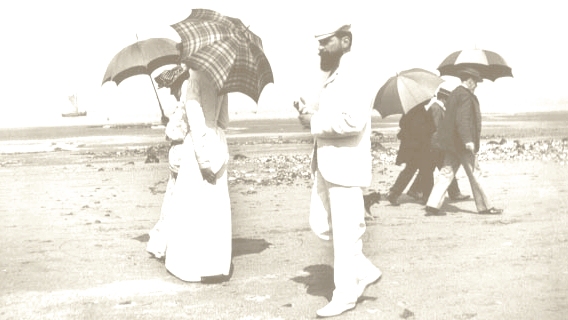
these are the timesdirty beloved
-

12.2.05

Origin of Name "Melungeon"

Portuguese diplomat Louis de Sousa added to Kennedy's research saying, "West Africans used the word Mulango to refer to white people. They would mean people from Portugal, as Portuguese were the first white people they saw."
It was never an approved Portuguese word.The term was used in many nationalities with various spellings, but similar pronunciation. This included the Portuguese, Berber, Arabic, Turkish, West Africa, and among the Spanish/Moors. It developed into meaning shipmates to these disenfranchised people. Some were captured, or of the lower classes sent from their homelands to battle or to colonize other lands. Mulungo is seen in Spanish folk stories according to Eloy Gallegoes, Spanish historian. Dr. James Guills author of the book, "Azores Islands, A History," 1993, told me that, the Portuguese word "Mulungo's for shipmate was used by all the families sent to the Azores. And, to all other places they went to colonize. All the people on board the ships sent to the Azores were Malungos and would identity themselves as such to anyone one they might meet. Or, to anyone they might encounter later in their new location." It was suggested to Kennedy that the sea travel of the Ottoman Turks should be looked at. They certainly conscripted a variety of nationalities into their vast Empire. People moving throughout the world in the 15th-18th centuries would be revisited. He learned from Turkish scholars, the term 'Melun can' among the Turkish Levant Ottoman soldiers was pronounced the same as Melunjun. Meaning lost or cursed soul. Arabic Melun jinn meant cursed spirit. Melungeon, with various spellings and similar sound, was used by the Turks, Moors, Arabs, and Portuguese. Was Melungeon perhaps used by others who considered themselves disenfranchised ethnic mixed peoples of 'fringe' tribes from the Caribbean, West Indies or elsewhere? Perhaps some sent to colonize, to battle, or as marauding lost traders, never to return to their home lands. Mulungo / Melunzhawn / Melun can / Melunjinn / Melungeons were all terms for disenfranchised people.
Evelyn McKinley Orr
Gowen Research Foundation


Robin Hood come again
Lowry is the “robber baron of the period; his stronghold is an island at the center of an almost inaccessible swamp in Robeson County …” He is a “chivalric cut-throat”; his band a “motley crew of Whites and Blacks, runaway slaves … deserted soldiers of both armies, and miscellaneous outlaws of every stamp.”
Editorial deploring Lowry’s recent exploits
New York Times 22 July 1871: P. 4 col. 5.
-
The Lumbee Indians: An Annotated Bibliography Supplement
Glenn Ellen Starr Stilling
Appalachian State University, Boone, North Carolina.


Henry Berry Lowry

Over a complicated series of accusations and incidents regarding thefts and conscription, the Home Guard shot Henry Berry Lowry's father and brother while he watched from hiding. Henry Berry and a group of supporters promptly stole a large quantity of rifles (purchased for the local militia) from the Lumberton courthouse and began an eight-year war to avenge the deaths. Henry Berry Lowry's tri-racial band also, Robin-Hood-like, robbed plantations, often showing up at dinnertime and dining with their hosts before carrying off the plunder in a mule and wagon. They stole two safes (one from the Sheriff's office and one from a large company), leaving them empty on the main street in Lumberton.
Henry Berry Lowry escaped from jail twice.
He and his band were outlawed in 1868--meaning anyone could kill them for the reward. The reward for Henry Berry Lowry climbed to $12,000, the largest offered in the 19th century except for Jesse James and Jefferson Davis.

Rhoda Strong Lowry: The Swamp Queen of Scuffletown

"Melungeon are an olive complected, dark eyed, dark skinned people living in Appalachia. Their claim of Portuguese descent was largely ignored and they have been historically dismissed as "tri-racial isolates", part African, Indian and White. Ironically, for a people accused of miscegenation, they marry only within their community. Some physical characteristics claimed by those of Melungeon descent are an Anatolian bump, a donut shaped protuberance on the back of the skull; shovel teeth, which are curved across the back rather than straight and end in a ridge at the gum line (also common to Amer-Indians); and Familial Mediterranean Fever, an inherited rheumatic disease ethnically restricted to non-Ashkenzi Jews, Armenians, Arabs and Turks. As racial tensions hardened around the Civil War their status as mulattos deprived them of basic rights such as property ownership and education."
Wayfaring Stranger
The Black Dutch, German Gypsies or Chicanere and their relation to the Melungeon
Linda Griggs
American Roma

What is a Melungeon?

"Suddenly I had too much for a short story. I had also done some research on our families and I knew we were kin to the Melungeons. I found out the people being written about were my relatives and owned a lot of the land all around us, including where we lived at one time. I found out we were right in the middle of a Melungeon colony. I knew by this time up to my fourth generation grandfathers were part of the Melungeon and were owners of a lot of this land. As a child I was told we were kin to the Melungeons.
I started spreading the word for I was so proud of this. Many a time in the beginning I was put down, but endured for I knew these people and most were good-hearted Christian people that would give you the shirt off their backs, or see to it you had food if you did not. That made me want to write about them more.
[...]
People started saying, “Why don’t you write a book?” I thought, “Book? I don’t know anything about writing a book” until one day a doctor friend of mine said to me, “Aw, you can’t write no book.” Then and there I thought to myself, “If it’s the last thing I do, I’ll show you” and so I did."

My Melungeon Heritage from Dogwood Press
Mattie Ruth Johnson
Melungeon Heritage Association
-
My Melungeon Heritage
by Mattie Ruth Johnson, from Dogwood Press

melungeon

Sjøormløpet

9.2.05


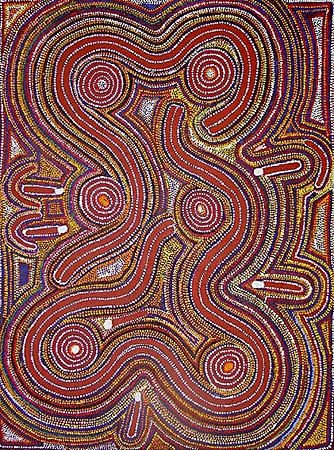
Fire Dreaming

Paddy Simms Japaljarri
Coo-ee Aboriginal Art
-
link path bilious young fogey via Barista


Bridge

Emily Bicht
-
link path open-ground via bloggy

Fabulous Ones
twoThis poem is brought to you by the letter C.

...crossing and uncrossing
the long, orange tubes of his legs, discussing

Chomsky, conditional freedom, and Cervantes

with anyone who will listen. He marches
against the war, a thousand people
at his back,
chanting...

Jeffrey Thomson
Verse Daily
09.Feb.05

8.2.05

Insects or bugs can also become trapped in the ear. Smaller insects, such as gnats, can become caught in the wax and be unable to fly out. They can often be washed out with warm water. Larger insects or bugs may not be able to turn around in the narrow canal. If the insect or bug is still alive, it can first be killed by filling the ear with mineral oil. This will suffocate the insect. The ear should soon after be evaluated by a doctor to have the pest removed.
Objects or Insects In The Ear
medicinenet

6.2.05


Eros and Psyche

Marble copy of original statue by Antonio Canova, made by Tadovino; Italy, 1834
-


statue of Demeter of Knidos c. 350 BCE
-


Melpomene, muse of tragedy

Roman copy; said to be from scaenae frons at the theater in Pompeii
-


polychrome mosaic portrait of a woman, Pompeii
-


gold bracelet in the form of a serpent Roman, first century CE

found on arm of woman who had apparently sheltered in a building in Agro Murecine (modern Moregine) near Pompeii; on the inside of the bracelet is carved "from the Master to his slave girl" (DOM[I]NUS ANCILLAE SUAE).
The woman was carrying a quantity of jewelry and several coins.
-


Julius Caesar
-

Barbara McManus
VRoma Project

Lawrence uses a noter which he calls a "chording stick" carved from hickory. A noter carved from mountain laurel was retrieved from one box which originated in Hickman County. The deep playing groove worn in the end and the owner's assurance that the box hadn't been touched in 60 years are evidence of the early noter style of playing. This particular noter was carved in the traditional style of noters common in the Galax area of western Virginia.

Tennessee Music Box
History, Mystery and Revival

-
The Sounds of the Tennessee Music Box
NPR
-
link path gmtplus9

4.2.05


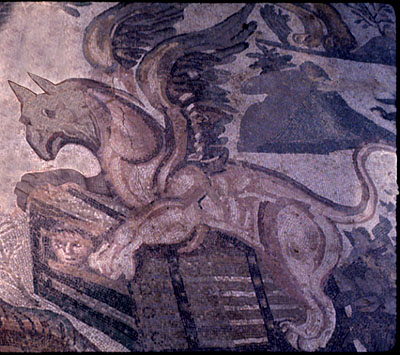
mosaic, Piazza Armerina, Sicily, 4th century CE

Venationes: Animals in the Arena
Gladiatorial Games
Barbara McManus
VRoma Project

19.1.05


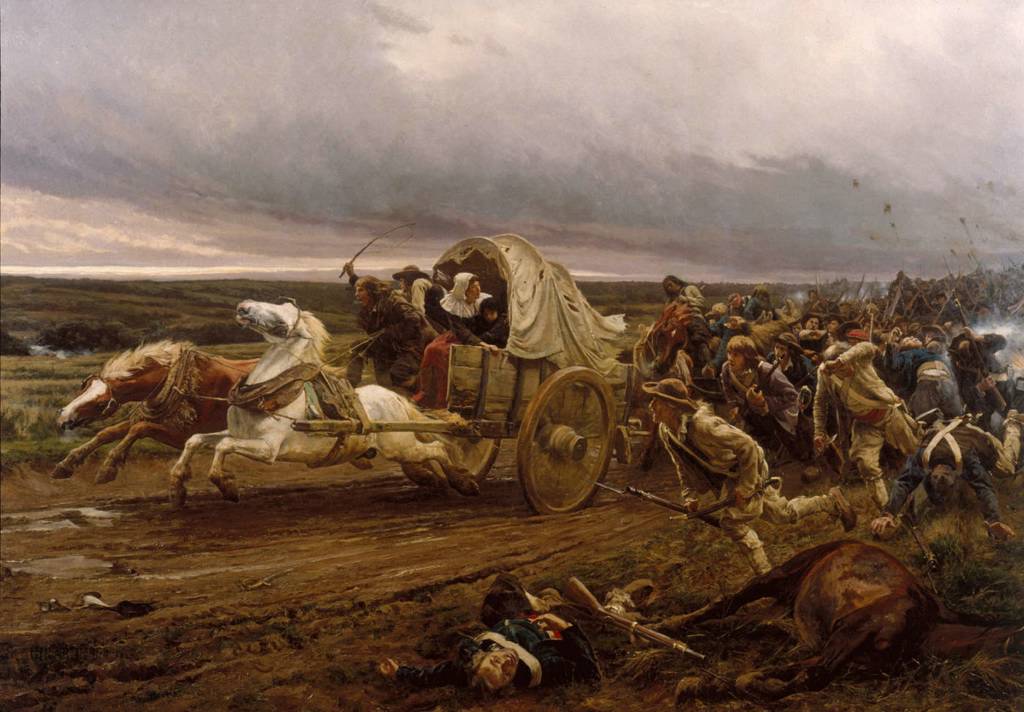
La deroute de Cholot, October 1793
o(detail)

Jules Girardet - 1883 t
L'HISTOIRE par l'image

18.1.05


Premiers essais du traitement du cancer par les rayons X 1907
to(detail)

Georges Chicotot
L'HISTOIRE par l'image

16.1.05


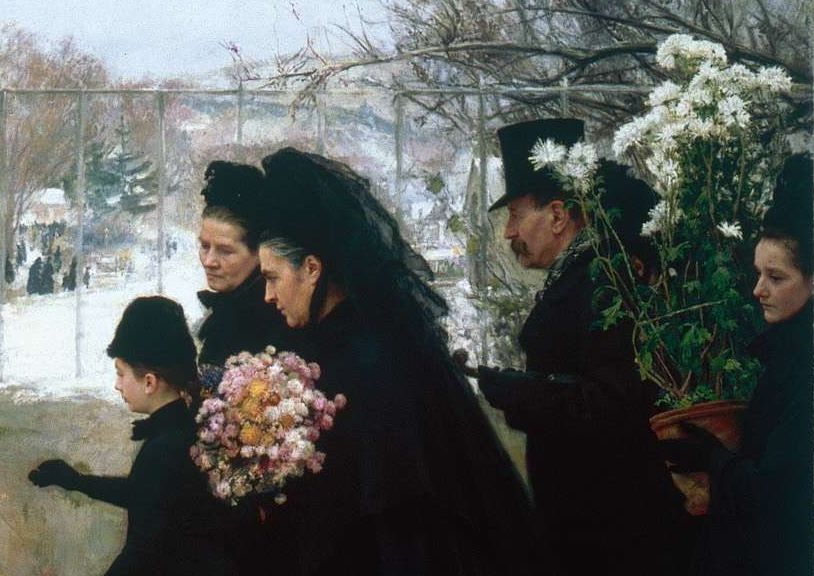
La Toussaintto(detail)

Emile Friant
L'Histoire par l'image ("...s'est donné l'ambition d'enrichir la connaissance du passé à travers les oeuvres d'art et les documents iconographiques qui s'y rapportent.")
Impressively well-executed site dedicated to art research, intended for secondary-school teachers and their pupils.
-
link path Dagnan-Bouveret search/meander prompted by Art "4" Today - 07.Jan

Blog Archive

Vivian

db annex larger,longer image-heavy posts