Inventory at Dusk
...So at first I was not needed.
I knelt under the sky blue sky
of the lips, and traced the final motion
where the hand had curled
like a fern...
[...]
...I sang for his wild mouth.
I sang instead of truth.
I sang for a place to lean on....
Robin Behn
Poetry Daily
25.Feb.05
26.2.05
25.2.05
I grew up inside that building. It was my home in my home town. I can't call it a house though, because it isn't a house, the garages underneath are for other dwellings, for other dwellers' use. So it's not independent like a house, not self-contained. Yet it's not an apartment, because it's by itself, there aren't any other apartments with it. It sits in the middle of a block, down a driveway past what was when I lived there the landlord's house, looking down on the neighbors' yards, their backyards, what are usually, in small towns, private spaces. You could see the park out the kitchen window, to the east. There were big trees in back that filled the windows and there was the driveway in front so you could see a car coming home. At the top of the stairs, which were steep, was the kitchen door, straight ahead. To the right at the landing at the top of the stairs was a window that also looked out on the park, like the kitchen window did. To the left was the living room door, the front door. The kitchen door had a sliding window in it and a screen on that. There was only a king-post between the two doors.
So, on the landing there were four perspectives, one behind you and one in front and two at either side, four differing lines, and the front door and the kitchen door were right next to each other, at right angles. And that was my home.
23.2.05
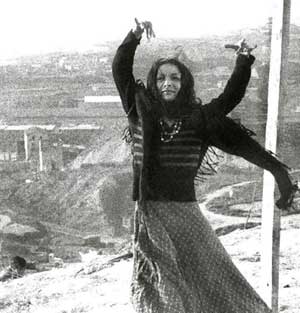
She was born in a thatched hut in Somorrostro. Her father was Francisco Amaya, "el Chino", a guitarist who made a harsh living "from one tavern to another, in permanent late nights of sour wine and thick vomit". When she was no more than four years old and was a skinny dark Gypsy girl, Carmen began to go out with her father at night to earn a living. The man played the guitar and the girl sang and danced. Then they passed the hat round, or simply picked up the coins the public threw on the ground.
“And the woman...that humanity she had that made her special. My family lived in Somorrostro, where Carmen was born, so they were neighbors.
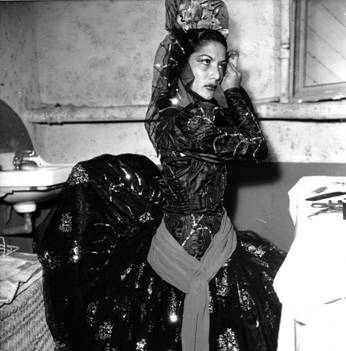 My older sister tells how she performed in the theater in Barcelona...all the tickets were sold out and many gypsies from Somorrostro couldn’t get in, either because they couldn’t afford it or because there were no tickets left. When Carmen found out, she went right to the neighborhood and danced for her ‘gitanicos’”.
Dolores Giménez
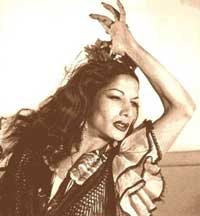
Flamenco today is deeply indebted to Carmen Amaya.Through her artistry and virtuosity, she effectively altered the history of flamenco dance forever.
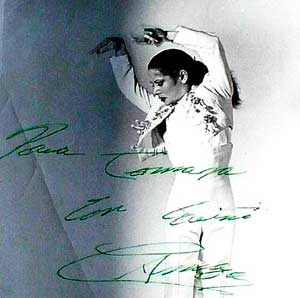
She crossed the traditional boundaries of flamenco by teaching herself the fast and furious footwork usually reserved for the male dancer. Donning a man's pants and jacket, she skillfully combined the elegance and grace of the female style with the ferocity and high-impact footwork of the male style sending shockwaves through the flamenco world unaccustomed to seeing a passionate and powerful woman in pants dancing a man's dance.
On his meeting with Carmen Amaya, Sabicas said, "We met when we were both children in Barcelona. I went to work there and I saw her dance one day – she was very young too. I became friends with her and her family." "I met Carmen in a restaurant called Casa de Manquet. There on the dock, where all the sailors used to go. A singer took me there, telling me, ‘Come, you’ll see someone dance’ I went in. The flamenco atmosphere was great. There was Carmen, very young. I was stunned to see what she could do... her hands, her feet... She carried everyone." "I saw her dance and it seemed like something supernatural to me... I never saw anyone dance like her. I don’t know how she did it, I just don’t know!".


Kazuo Ohno was born in 1906 in Hokkaido, Japan.
In 1926 Ohno made his way to Tokyo where he enrolled in the National School of Athletics. Shortly afterwards he encountered a performance of the Spanish dancer La Argentina, and began to dance. La Argentina inspired something in Ohno that never left him and became the impetus of his most famous performance Admiring La Argentina. Of La Argentina Kazuo said, "The dance of La Argentina invited people into a sea of excitement. She embodied dance, literature, music and art and furthermore she represented love and pain in real life."
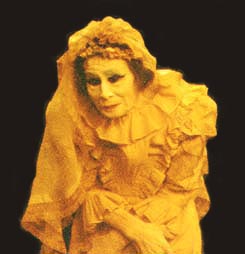
How to explain the dance performance of a 90 year old man? To merely describe the movement style or the choreography does not really bring forth the grace and dignity of his presence. Kazuo Ohno "performs" with the expression on his face, each small gesture and even in his stillness.
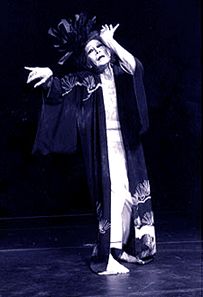 His form of Butoh dance is one in which structure is not most important. Instead, he is interested in bringing to life a quality of being embued with energy and emotion. His movement is not technically skilled but filled with an almost mystical sincerity.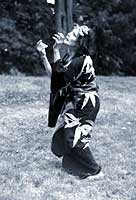
The curtain call is also a great part of this performance experience. Ohno comes down stage to communicate his thanks for the applause. He remains on-stage, laying on the floor, bowing, kneeling, ready to wait with us until we decide to end the applause. This has just the opposite affect, causing a standing ovation, which in turn causes Ohno to leap across the stage, smiling and making idiosyncratic, often humorous, gestures. All of this is sincere and spontaneous. There is nothing rigid about his place on stage and our place in the audience.
During the five years of performance before he and Hijikata met, Ohno's work was notably inspired by the evocations of the spirit. Said Kazuo Ohno of his greatest inspiration, "I had read about the creation of the world in the Bible; I'd always accepted it as a legend, but in La Argentina's work I saw it realized in front of my eyes. If this is creation, I would like to lift one corner of it."

21.2.05


Portrait of Mary Ellen Meredith
Henry Wallis
-
"Henry Wallis's deeply sensitive portrait of his lover, the beautiful Mary Ellen Meredith (1821-61) dates the same year that she gave birth to their son Harold, known as Felix, who was born in April 1858.link Art "4" "2" -Day 21.Feb.05
[...]
Mary Ellen was an adept writer, she was witty, intellectual and free-spirited. Holman-Hunt described her as a "dashing horsewoman", while C. L. Clodd's Memoirs recalled that those "who knew her say she was charming, with intellectual gifts above average". She was a woman who broke all Victorian conventions when in the summer of 1857 she left her husband. Contrary to popular belief she did not elope with Wallis immediately although their affair had probably begun in about February that year. Rather the independently minded Mrs Meredith went with her two small children to Seaford, intending to live by her own writing and on a small private income. During the late summer she and Wallis spent a glorious holiday in Wales and the following April their son Harold was born. She was the eldest of five children, born in Stamford Street London in July 1821. Following the death of her sister in 1826 her mother suffered increasing mental illness so Mary Ellen was largely raised by her adoring father, who taught her to pursue life and knowledge to the full.
Thomas Love Peacock, a child of the enlightenment, was closely associated with such figures as John Stuart Mill, T. J. Hogg and P. B. Shelley, who with the feminist Mary Wollstonecraft and her daughter Mary Shelley as well as the unfettered Claire Clairmont served as dominant role models in Mary Ellen's life.
From her youth Peacock's daughter wrote prose and poetry and with her father compiled a number of cookery books. Her precocious childhood culminated in a tragic first love when her first husband, Edward Nicolls was drowned at sea in March 1844, three months after their marriage. By then she was expecting her first child, Edith. Enter the then unknown writer, George Meredith, who was handsome, brilliant and charming and seven years her junior. Though he later denied it, Meredith fell in love immediately and after six proposals they married in 1849. At first all appeared well, both pursuing their literary careers, at times Meredith publishing her work under his own name. But financial constraints, a lack of mutual understanding, numerous miscarriages and infant deaths, despite a healthy son named Arthur, led to irreconcilable difficulties. The situation was not helped by Thomas Peacock's obvious dislike of his son-in-law, especially as the latter did not share the family's culinary passions."
pages devoted to George Meredith
The Golden Key (on-line resource for all things related to Victorian novelist, poet and Christian Fantasy writer George MacDonald (1824-1905) and home to the Wingfold email list)
19.2.05
Bent to the Earth
...a child
who had seen what a piece of polished wood
could do...
Blas Manuel De Luna
Poetry Daily
19.Feb.05
18.2.05
Young, Myathe (colored)
Book #1, Page # 326
Inmate # 0651
Date admitted: 4 May 1896
Date last discharged: 27 Jul 1903
Age: 3
Sex: F
Born: 1893 -year only given-
Place: Miami Co., Oh
Comments: Sister to #0659, #0650. Parents Harry and Viola Young, separated. Taken by mother. Readmitted. Indentured to Charles Guthrudgem Addison, Ohio in ( ) Christiansburg, Ohio.
NOTE

17.2.05

Street Photographer, Johannesburg 1948to(detail)
Creator: Larrabee, Constance Stuart, 1914-2000,
Title: Street Photographer, Johannesburg.
Contained in: Constance Stuart Larrabee photographs, 1935-1988
Produced: 1948
In 1945, Constance Stuart returned from her assignment as the first female South African war correspondent in World War II. Her reputation as a photographer grew. She maintained a photographic studio in Pretoria and Johannesburg. This series of images which she entitled "Johannesburg Black Man" depict life in downtown Johannesburg and in parts of the city, where Black South Africans lived, such as Sophiatown, Pimville, and Newclare. A second series of images focuses on Father Huddleston's work in Sophiatown. In 1948-1949, in the early days of apartheid, Stuart documented the building of the South Western townships (Soweto) and the way Africans adjusted to this new environment.
There are no prints of this negative in the Constance Stuart Larrabee Collection. EEPA produced an 8x10 study print for reference purposes.
The cataloging of the Constance Stuart Larrabee Collection was supported by a grant from The Smithsonian Women's Committee.
-
Horizon Information Portal 3.06.A
Archival, Manuscripts & Photographic Collections
SIRIS - Smithsonian Institution Research Information
Smithsonian

In The Summerhouseto(detail)
George Tooker at the Smithsonian
Artcyclopedia
-
lantern riddle guessing
-
leylop explains Lantern Festival
-
Lantern Festival: Yuan Xiao China Daily
-
“eating taro under the lanterns”


12.2.05
Title: Blushing rose
Performer(s): Whitt, Myrth, b. 1902?
Recording Date: 1941-07-28
Description: Place of recording: Crandon, Wisconsin
Heard this song by relatives of her husband in Kentucky. Her first and only sweetheart sang it to her when she was 16. It was never heard anywhere else.
Subjects: Love / Voice
Language: English
-
Wisconsin Folksong Database: Helene Stratman-Thomas Collection
Mills Music Library Special Collections
University of Wisconsin Digital Collections
Unbeknownst to your busy editor prior to all this in-gathering, the wonder-cabinet-analog Fortean Times has a link to a Melungeon-related article in the Morristown, Tennessee Citizen-Tribune up in its current online edition.
How Fortean.
Though it's mostly about "Big Haley" Mullins, and mostly about her obesity.
Mattie Ruth Johnson, below, is related to Big Haley on both sides of her family. I'd guess her coverage of this legendary moonshiner would be more interesting.
A picture on that last link above shows Ms. Mullins to have been a large, stern-looking woman.
-
Wired also had some articles that were somewhat helpful.
Another version of the origin of the Melungeon, this time Africa:
They first settled in Virginia one year before the Pil-grims landed at Plymouth Rock. They were free Americans 150 years before George Washington fought the British.African Origins of the Melungeons
Some of their descendants are world famous: Abraham Lincoln through his mother Nancy Hanks, actor Tom Hanks, Elvis Presley, Heather Locklear, Ava Gardner, comedian Steve Martin, singer-writer Rich Mullins and many others.
Yet the African-American ancestors of mixed groups like the Melungeons and their brothers, the Lumbees, Red Bones, Brass Ankles, and others are only now beginning to emerge from the dim mists of early American history.
The following advertisement was placed in the North Carolina Gazette on April 10, 1778 by Johnson Driggers, a desperate Melungeon father seeking his abducted children.Malungu: The Mbundu-African Origin of the American Melungeons
"On Saturday night, April the 4th, broke into the house of the subscriber at the head of Green's Creek - where I had some small property under the care of Ann Driggers, a free Negro woman - two men in disguise, with marks on their faces and clubs in their hands, beat and wounded her terribly and carried away four of her children, three girls and a boy, the biggest of said girls got off in the dark and made her escape, one of the girls name is Becca, and other is Charita, the boy is named Shadrack..."
This early newspaper notice described a common threat to free blacks and Melungeons in 18th century America. The lucrative American slave market enticed man-stealers to prey on free African and free mulatto communities. Freeborn mulatto Drury Tann of the Melungeon Tann family of North Carolina, applied for his Revolutionary War pension in 1834. In his pension application is an account of his early abduction by man-stealers.
"He (Tann) was stolen from his parents when a small boy by persons unknown to him, who were carrying him to sell him into Slavery, and had gotten with him and other stolen property as far as the mountains on their way...his parents made a complaint to a Mr. Tanner Alford who was then a magistrate in the county of Wake State of North Carolina, to get me back from those who had stolen me and he did pursue the rogues and overtook them at the mountains and took me from them."
On March 12, 1754, John Scott, a "free Negro" of Berkely County, South Carolina with Melungeon ties filed an affidavit notifying authorities in Orange County, North Carolina of a similar abduction.
"Joseph Deevit, Wm. Deevit, and Zachariah Martin entered by force the house of his daughter, Amy Hawley, and carried her off by force with her six children, and he thinks they are taking them north to sell as slaves."
Tim Hashaw
Gowen Research Foundation
For centuries, they remained almost invisible to the American mainstream. They live hidden away on inaccessible mountain ridges, and a racially segregated society wrote them off as a mixture of white, black and American Indian.Richard Lister
Now, evidence is emerging which suggests that the Melungeons may have been among America's very first settlers, arriving in Appalachia long before the Northern Europeans.
[...]
Sir Francis Drake unloaded hundreds of other Turks after he liberated them from the Spanish in 1587. Blood typing has confirmed close similarities between present day Melungeons and people of the Mediterranean region.
What has now become known as the Kennedy theory is that these people pushed inland and settled down with American Indian women, to begin life as farmers.
With his team of researchers, Dr Kennedy has found hundreds of words in local Indian dialects that have almost the same meaning in Turkish or Arabic.
The Cherokee word for mother for example, is Ana Ta. In Turkish, the word for mother is also Ana-Ta.
Dr Kennedy says the word Melungeon is derived from the Arabic "Melun-Jinn" meaning one who has been abandoned by god - a cursed soul.
BBC News
By 1670, while colonial Spain no longer figured as an active presence, Spanish recruits and their descendents did. It is also very likely that in settling in the mountains of western North Carolina, Kentucky and Tennessee, they intermarried, and/ or settled with established Native communities. Thus, they are perhaps some of the ancestors of the modern Melungeons, Lumbees, and other Native and/or Native descent communities of the Southeast. Among Melungeons, names one only finds in Portugal, such as Elvas or Elvis, Navarro or Navarrh, and Canara, are still popular (Kennedy 1994:107). In fact, Elvis Presley, who hails from Tennessee, was most likely of Melungeon descendent. Among Lumbees, the common tribal name Chavis would originally have been pronounced and spelled Chavéz in Spanish, or Chaves in Portuguese. It is this latter spelling that is still in common use by Lumbees today. During the course of 300 years, considerable mixing between these two related, yet distinct communities, along with others, also occurred.Political History of the Lumbee Indians - Coalescence
Malinda Maynor
The sense of superiority which naturally arises when one group takes control of another's destiny is no new phenomenon. It runs through the history of mankind and this is why this writer considers the Melungeon movement to be so important at this juncture in history as a force resistant to racist rhetoric so that persons who acknowledge the contribution of their multi-ethnic ancestors reflected in their own lives powerfully disprove charges of intellectual inferiority which the bigoted would like to see as inherent in any one people.
On one hand, the South Carolina courts were in essence saying that a mixed race person with property and known association with whites could be deemed white with all the attendant privileges of that status but, on the other hand, a slave, no matter how far he was removed from his African ancestry, could have no such aspirations. In Barbados, the principle was the same, though strongly denied. The closeness that obtained between Barbados and the Carolinas and Virginia in particular with so many persons of the pioneer companies having proceeded from Barbados makes this phenomenon very understandable as the genesis for the need for isolation and the imparting of extreme prejudice to subsequent generations which, in Barbados, gave birth to a visibly white community yet known as Red, their original status.
The Calendar of State Papers for 1657 gives the unique description of the labour policies on Barbados in which the Irish "were derided by the negroes as white slaves" and records that negroes were being employed at trades rather than the the English, Scotch and Irish. Two years before the official report it was recorded that the import of Irish people as labour was being resisted by the English because the Irish were wont to throw in their lot with the escaped slaves yet the written record on Barbados is that the Irish never intermarried with the escapees they joined forces with.
Forbes came to the conclusion that many of the removed Native Americans were engaged in fishing activities. Early Barbados history confirms that the captured natives were being used as fishermen as well as house servants and coincidentally, pockets of white communities with a non-European culture were springing up being termed Red-Legs or Poor Backras marrying among themselves. Early photographs of Red-Legs show a marked resemblance to some of Kennedy's portraits of Native American and Melungeon families.
On Barbados, the Red-Leg community centered on the hilly, isolated areas of Irish Town and the Scotland District which has led historians to believe that they were an unmixed remnant of Scotch-Irish. The eating habits formerly ascribed to them of eating lice, crickets and bonavist, a type of bean, however indicates more than Irish origins. Impoverished through lack of opportunity these communities were referred to as "abandoned people".
Barbados and the Melungeons of Appalachia
L.E. Salazar
The Melungeons.com
Subscribe to:
Posts (Atom)