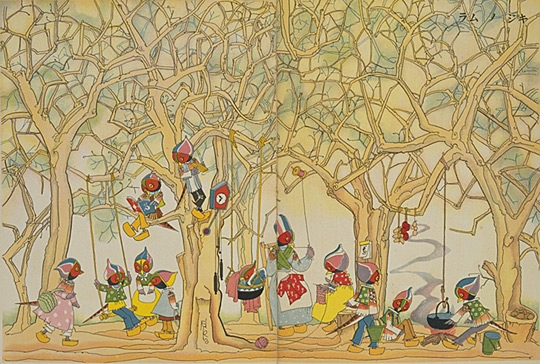
Pheasant VillagetodetailThis Town, That TownKawakami Shiro
Kodomo no kuni
artists and children's books in 1920's Japan
children's songs
This Town, That Town
Boats of Leaves
mp3:
Taanki, Poonki
Pheasant VillagetodetailThis Town, That TownKawakami Shiro
Kodomo no kuni
artists and children's books in 1920's Japan
children's songs
This Town, That Town
Boats of Leaves
mp3:
Taanki, Poonki

Einstein Tower, Potsdam, Feb. 2001
Stefan Rahmstorf
"After hearing the war reported like sports commentary between gardenias and kittens on the radio, Boynton retreated to an empty large park in an unfashionable suburb, where the unfashionable pines are getting removed by the reconstructed creek, and the vistas are getting landscaped – and on opposing open hills these are quite beautiful. Bare. And barely anyone there. It was partly nostalgia for the kind of remnant bush and exotic dotted ex-orchard country of her outer-suburban childhood, with the strong, wet smell of pine needles, and the brick villas always on the fringes of the frame. Nostalgia because neither landmarks nor family are to be found out there anymore, sentimental because yesterday boynton saw a low cream brick fence of the fifties and lamented a lost world."
Updated to reflect accurate spelling(s)In every attempt at defining these online journals that I've read, for all the "blogs" and "blogospheres" and "bloggers", there's never been anything but the most cursory recognition of work like Mark Woods'. And yet for a lot of us his daily spread is essential, and a constant welcome challenge.
Eugene Kuo has some photos up of a trip he took to Turkey, of which this is one.
mp3:
Fania Tei
-
Fania at Calabash Music
The public domain is not a waste basket, it's not a gutter or a vacant lot or a graveyard; it's closer to dirt, but real dirt - the kind you come to when you dig beneath trees - it's alive.
The public domain is central, not peripheral.
The merchants' edge is a like a fungus, a parasitic growth, and for a lot of us, who grew up completely disconnected from any other way, that growth seemed to be all there was. But the online world has created a refutation of that, an unstoppable return to what the public domain really is. Which is not an economic term. Public domain only became a legal term when merchants began making the laws.
The public domain is ours, we are the public and this is our domain. Merchants have attached themselves to that, strip-mined it, harvested it, clear-cut it.
It's a kid's logic - the question, why aren't the best-seller lists representing the all-time best? The answer being because there's no profit in it. Merchants determine what's available according to what sells. The stores sell things. And we're brainwashed into thinking the store is the only place to get music, or books. You have to buy it. Your relationship with it has to be economic first.
Music is a commodity, a luxury, economically secondary, unnecessary. Even though it's a virtual necessity in many people's lives, especially among the young and mating, even though people take music with them everywhere, turn to it for comfort, use it for solace. The most important human events, marriage, funerals, inaugurations, graduations, virtually everything but birth itself, which has its own songs, is held together by music, the participants are united by music. That's not peripheral, and it's not a luxury, it's essential.
Online file-sharing, that was in its beginning hackers and college kids mostly, has turned into a place where people share music they like and love, and it has nothing to do with immediate gain in many cases. So lo and behold there's music with no price tag, side by side with the latest corporate artists, just like it is in our lives.
The mercantile idea is that music from 50 years ago is less important than music made today. But that's only true to the people who sell it.
It's like cars. Cars must be new. The idea of having a car for thirty years, much less the absurd idea of having a car you maintain and pass down to your children, is unthinkable for most people.
And yet we do that, and do it lovingly, with furniture, with clothing, blankets even, dishes, hand tools. How many of us have things our parents used, our grandparents, an uncle or an aunt. Or things we got at garage sales that were old and well-used, and valued because of that? But a car? Older than twenty years? An antique, a hobby.
This is corporate brainwashing, and in its destructiveness it's evil pure and simple. By any definition, once all the effects are accounted for, it's evil.
-
The bookmarks below are nearly random links to music sites. Some of them are indexes of music sites themselves. This is not an informative list, or a project; it doesn't represent my taste musically, just links that ended up in this one bookmark island after a month or two of accumulation.
Absolute Cherry
Naiadtodetail
Blood, Sea
Janaina Tschäpe
USFCAM

Diamond Chroma
Richard Anuszkiewicz
"...The gentleness between the one-legged man and his monstrous wife
Almost too much for me..."
Leaving Beirut
Roger Waters
-
link 3rd world view
The bell casting is then taken to the tuning shop where it is placed, mouth upwards, on a large vertical lathe which has a revolving turntable. The bell is struck with special mallets to vibrate the metal in the areas which produce the main harmonics. After assessment by the Bell Master, the Bell Tuner removes small chips of metal uniformly from the inside of the bell until the vibrations of each of the main harmonics reach the correct frequency.Bells in the Making
There are hundreds of indigenous languages still spoken today in Latin America, although there were probably as many as 1,750 before the beginning of the European invasions (Sherzer, 1991). Campbell (1997) reports between 550 and 700 languages for the whole region, citing sources from the mid-1990's.
There are some 56 language families and 73 isolates (a language with no known relatives) in Latin America (Kaufman, 1994a&b). For comparison, there are only two language families in Europe - Indo-European and Finno-Ugric - and one isolate, Basque. [Look at thelanguage families tables.]
Linguists divide the languages of the Americas into three groups:
At noon I attended Mr. Potholt, who is not young, and totally blind, to the tower of the Stad-huys or townhouse, of which he is carillonneur; it is a drudgery unworthy of such a genius; he has had this employment, however, many years, having been elected to it at thirteen. He had very much astonished me on the organ, after all that I had heard in the rest of Europe; but in playing those bells, his amazing dexterity raised my wonder -much higher; for he executed with his two hands, passages that would be very difficult to play with the ten fingers; shakes, beats, swift divisions, triplets, and even arpeggios he has contrived to vanquish.Dr. Charles Burney,1773
He began with a psalm tune, with which their High Mightinesses are chiefly delighted, and which they require at his hands whenever he performs, which is on Tuesdays and Fridays. He next played variations upon a psalm tune, with great fancy and even taste. When he had performed this task he was so obliging as to play a quarter of an hour extempore in such a manner as he thought would be more agreeable to me than psalmody; and in this he succeeded so well, that I sometimes forgot both the difficulty and defects of the instrument. He never played in less than three parts, marking the bass and the measure constantly with the pedals. I never heard a greater variety of passages in so short a time; he produced effects by the pianos and fortes, and the crescendo and the shake, both as to loudness and velocity, which I did not think possible upon an instrument that seemed to require little other merit than force in the performer.
But surely this was a barbarous invention, and there is a barbarity in the continuance of it. If Mr. Potholt had been put into Dr. Dominicetti's hottest human caldron for an hour, he could not have perspired more violently than he did after a quarter of an hour of this furious exercise; he stripped to his shirt, put on his nightcap, and trussed up his sleeves for this excution; and he said he was forced to go to bed the instant it is over, in order to prevent his catching cold, as well as to recover himself; he being usually so much exhausted as to be utterly unable to speak...
6 Riddles From the Exeter Book
...though she who takes me might flinch first.
I'm well set up. Stand erect in bed.
A bit hairy at the root.
two thousand and fiveNow and again
some bloke's daughter (and a looker!)
wraps her hand around me and pulls
my rosy top, and takes my head
right into her pantry — one of those girls
with spunk....
Crispin Elsted
Poetry Daily
18.Sep.04
Tiny account size, mp3-wise, means only one or two songs at a time.
But this beautiful, haunting, very feminine music,
Porale Ponuthaye sung by Swarnalatha,
at Under The Fire Star, was a call to arms, as it were.
So, in acknowledgement, as resonant confirmation,
and a reminder of how big this family really is,
from Russia:
The Soul Laments mp3 (3.09mb)
Sirin Ensemble